

For buyers, engineers, and sourcing professionals in the metal stamping world, quality problems are rarely a surprise when you look back at where they started. A cracked part, an out-of-tolerance dimension, a wrinkle that shows up three weeks into a production run, these issues can almost always be traced back to a decision made long before the first piece of steel ever touched a die. That’s the entire premise behind Advanced Quality Planning (AQP): the best time to solve a quality problem is before it exists.
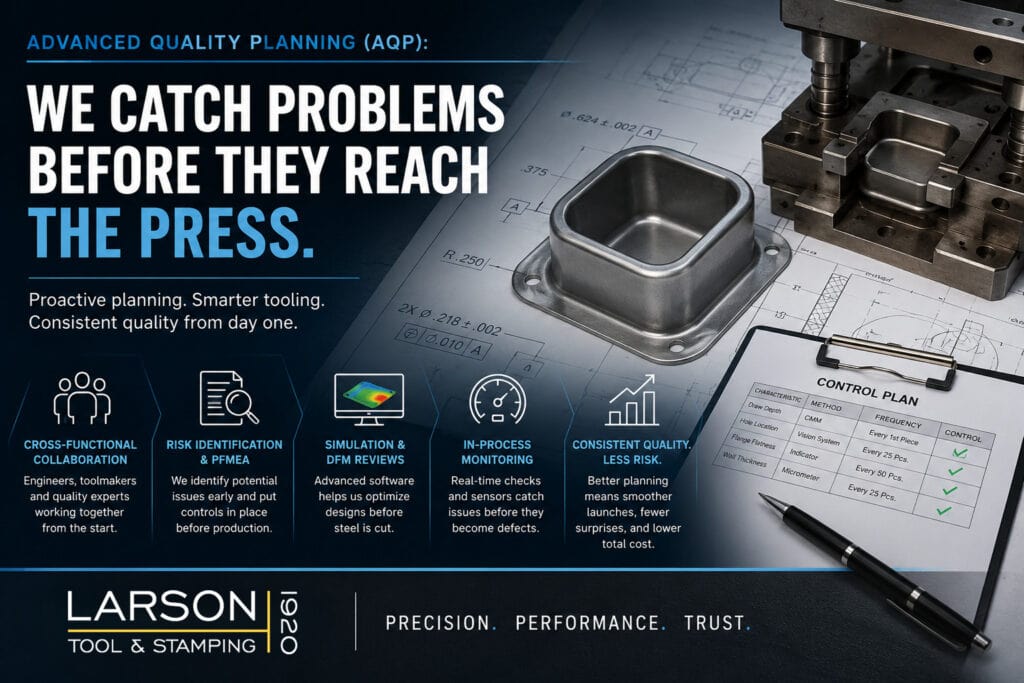
At Larson Tool & Stamping, AQP isn’t a checkbox exercise or a document that gets filed away after a program launches. It’s a structured, cross-functional process that runs in parallel with tool design and part development, and it’s one of the biggest reasons our customers see fewer surprises once production ramps up.
What Advanced Quality Planning Actually Means
AQP is a proactive framework for identifying what could go wrong with a part or process and then engineering those risks out before they ever reach the press. It draws heavily from methodologies like APQP (Advanced Product Quality Planning) and PPAP (Production Part Approval Process), but the real value isn’t in the acronyms, it’s in the discipline of asking hard questions early, when changes are cheap, instead of late -when changes are expensive.
At its core, AQP asks a simple set of questions for every new part or program:
- What is this part actually supposed to do, and what tolerances matter most to that function?
- Where has this geometry, material, or process caused problems before?
- What could vary from run to run, material lot, press setup, tool wear; and how much does that variation matter?
- How will we know, in real time, if something starts to drift?
Answering those questions requires input from design engineers, toolmakers, press operators, and quality technicians all at the same table, not in separate silos handing work off to one another after the fact.
Why This Matters Long Before the First Part Is Stamped
Deep draw stamping in particular is unforgiving of problems discovered late. Once a die is cut and hardened, correcting a geometry issue or a material incompatibility is far more expensive, in both time and dollars, than catching it during design review. This is why Larson’s AQP process begins the moment a print or 3D model lands on our engineers’ desks, well before any tooling is committed to steel.
Our engineering team conducts a Design for Manufacturability (DFM) review on every new program, evaluating draw depth, radii, wall thickness transitions, and hole placement against what the material and process can realistically achieve. Where a design tweak of a few thousandths of an inch could mean the difference between a part that forms cleanly and one that tears or wrinkles, we flag it and work with the customer’s engineering team to resolve it collaboratively; while it’s still just a line on a drawing.
From there, we build a Process Failure Mode and Effects Analysis (PFMEA) for the part, systematically walking through every step of the stamping process to identify where failures are most likely to occur and how severe the consequences would be. This isn’t a generic template, it’s specific to the part, the material, the tooling, and the press it will run on. High-risk steps get additional controls: poka-yoke error-proofing, in-die sensors, secondary checks, or adjusted process parameters.
What This Looks Like on the Shop Floor
AQP isn’t just a planning document that sits in a binder, it shows up in tangible ways once a program moves into production:
Simulation before steel is cut. Using finite element analysis (FEA) and forming simulation software, our engineers can model how a part will actually behave under the press, predicting springback, thinning, and wrinkle risk, and adjust the die design accordingly before it’s ever built.
Control plans tied to real process data. Every critical characteristic identified during PFMEA gets a corresponding control plan: what gets measured, how often, by what method, and what happens if a reading falls outside spec. These aren’t static documents; they evolve as we learn more about how a part behaves in production.
In-process monitoring. For high-risk features, we build in sensors and checks directly into the tooling and press cycle, catching a problem on the first bad part instead of the five-hundredth.
First article and ongoing capability studies. Before full production begins, we validate that the tooling and process can consistently hold the required tolerances, using statistical process control (SPC) to confirm capability rather than assuming it.
Why This Matters to Buyers
For purchasing managers and sourcing professionals, AQP translates directly into fewer disruptions to your supply chain. A supplier who has thoroughly planned for quality before production starts is a supplier who isn’t calling you mid-run to discuss a design change, a missed delivery, or a containment action. Program launches go smoother, first-article approvals happen faster, and the total cost of the part, not just the piece price, comes in lower because rework, scrap, and expedited freight rarely enter the picture.
Why This Matters to Engineers
For engineers, working with a stamping partner who practices genuine AQP means having a collaborator, not just a vendor. Design intent gets preserved because manufacturability concerns are raised early enough to address without compromising function. And when trade-offs are necessary, they’re made together, with full visibility into why a particular radius or draw stage matters.
Why This Matters to Quality, Ultimately
At the end of the day, AQP exists to make quality boring, in the best possible sense. When problems are identified and engineered out before a tool is built, quality control on the production floor becomes about confirming consistency, not chasing it. That’s the difference between a reactive quality department and a proactive one, and it’s the standard Larson holds itself to on every program. Since 1920, Larson Tool & Stamping has built its reputation on delivering consistent, high-quality parts throughout the life of a program, and that reputation starts long before the first part ever reaches the press. If you’re evaluating a new stamping program and want a partner who thinks about quality from day one, we’d welcome the conversation.
About Larson Tool & Stamping Company
Since its inception in 1920 in Attleboro, MA, Larson Tool & Stamping Company has been making a difference as a valued supplier of precision metal stampings and assemblies to hundreds of companies in the United States. Larson provides high-quality, cost-effective solutions with our wide range of capabilities that include forming, stamping, deep drawing, machining, assembly, brazing, coining, and water-jetting. Through significant investment in leading-edge manufacturing equipment and the loyal support from customers and co-workers, Larson perpetuates the commitment made by our founders to do whatever is necessary to meet and exceed customer expectations.
Have a question about the metal stamping world?
Submit it and we can incorporate it into an upcoming blog!