

Quick answer: The 2026 U.S.-Canada trade dispute has raised steel and aluminum input costs, lengthened lead times, and made stamping quotations less predictable for buyers of stamped metal components. Section 232 tariffs of up to 50% on covered steel, aluminum, and copper products, combined with Canadian retaliatory tariffs of 15%-50% on roughly $20 billion of U.S. goods, are pushing buyers to prioritize suppliers with strong material sourcing, domestic manufacturing, and flexible inventory planning — not just the lowest piece price.
For companies that purchase stamped metal components, the relationship between the United States and Canada has always been more than a matter of geography. The two countries have built one of the most interconnected manufacturing relationships in the world, with steel, aluminum, automotive components, machinery, fabricated parts, and countless other products moving across the border every day. For the metal stamping industry, that close relationship has traditionally provided manufacturers with access to reliable material sources, established supply chains, and a large North American customer base.
Today, however, that relationship is facing significant uncertainty.
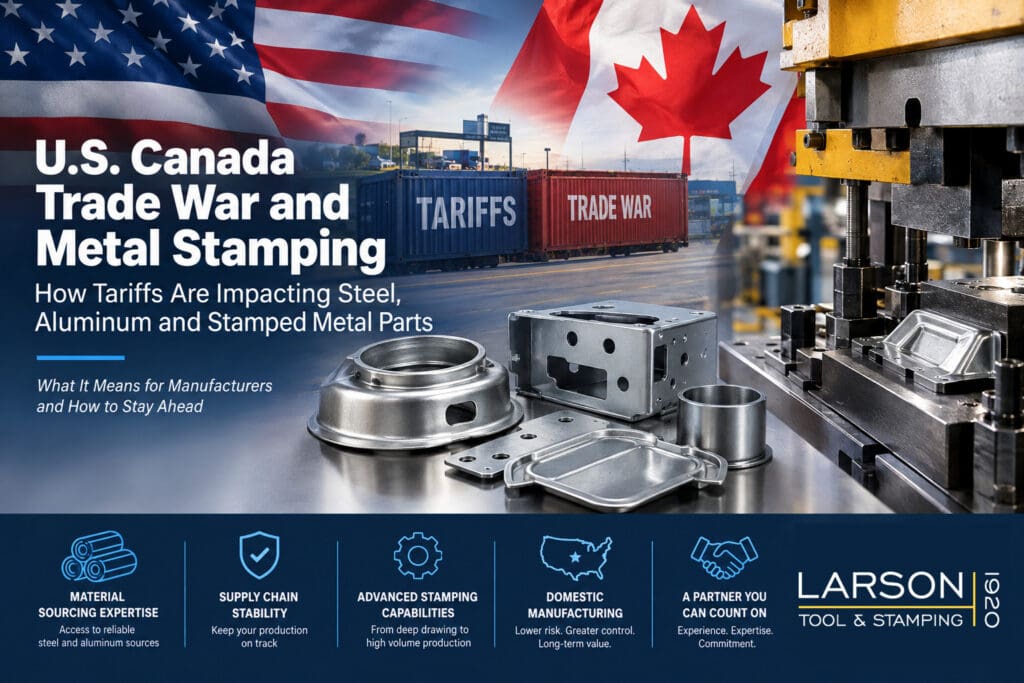
As of September 2026, the ongoing trade dispute between the United States and Canada is creating new challenges for manufacturers, metal stampers, and companies that purchase stamped components. Changes in tariffs, retaliatory Canadian tariffs, shifting trade negotiations, and uncertainty surrounding the future of North American trade are making material costs and supply chain planning more difficult. The situation is particularly important for metal stamping because steel and aluminum are fundamental inputs for the industry.
For companies purchasing stamped parts, the effects of the trade dispute can extend far beyond the price of a coil of steel or aluminum. Material availability, purchasing decisions, inventory planning, lead times, quoting, production scheduling, and the overall cost of a finished stamped component can all be affected.
At Larson Tool & Stamping, we understand that our customers need more than a supplier that simply stamps metal. They need a manufacturing partner capable of anticipating problems, managing material challenges, maintaining production schedules, and helping them navigate an increasingly complicated supply chain.
Why Do Steel and Aluminum Tariffs Matter to Metal Stampers?
The metal stamping process begins long before a blank enters a stamping press. The material must be specified, sourced, purchased, inspected, delivered, and made available for production. When the cost or availability of that material changes, the effect can eventually reach every stage of a stamping program.
The current U.S. tariff structure has placed particular attention on steel and aluminum. Under the current Section 232 tariff framework, many steel and aluminum products and derivative products entering the United States can be subject to significant duties. The administration modified the Section 232 framework during 2026, including tariffs of as much as 50 percent on certain covered steel, aluminum, and copper products, while some derivative products have different rates.
Canada is especially important because it is deeply integrated into the North American metals supply chain. Canadian producers supply substantial quantities of steel and aluminum to the United States, while American manufacturers also sell significant amounts of metal and manufactured products into Canada.
That means tariffs do not simply affect a Canadian company selling material to an American customer. They can create a ripple effect throughout the entire manufacturing chain.
A Canadian mill may face higher costs when selling material into the United States. A U.S. manufacturer purchasing that material may then face a higher landed cost. A metal stamper purchasing the material may need to adjust its quotation. Finally, the company purchasing the stamped component may experience an increase in its total component cost.
The result is that a tariff imposed at an international border can ultimately influence the economics of a finished component being manufactured thousands of miles away from that border.
Key Tariff Facts (2026)
- Section 232 tariffs: up to 50% on certain covered steel, aluminum, and copper products entering the U.S.
- Canadian retaliatory tariffs: 15%–50% on approximately $20 billion of U.S. imports, including steel and aluminum.
- U.S.-Canada trade negotiations broke down in August 2026, after earlier discussion of tariff reductions.
- Status as of September 2026: tariffs and retaliatory measures remain in effect, with continued uncertainty over future changes.
Is the Cheapest Material Really the Lowest Cost?
One of the biggest misconceptions surrounding tariffs is that their impact can be measured simply by looking at the percentage increase applied to the material.
For metal stamping buyers, the real issue is much broader.
When material prices become unpredictable, manufacturers must consider how long a quoted material price can realistically remain valid. A stamping quotation prepared today may be based upon a specific steel or aluminum price, but that price can change before an order is released. If a tariff changes during that period, the economics of the project can change as well.
Material availability can also become a concern.
When manufacturers anticipate additional tariffs or shortages, they may purchase additional material in advance. This can increase demand and place additional pressure on mills, service centers, and distributors. Customers may then experience longer lead times or reduced flexibility in obtaining the precise material specification required for a particular stamped component.
This is particularly important in metal stamping because material specifications are not interchangeable simply because two materials may appear similar on a material chart.
A change in material grade, thickness, hardness, temper, coating, or mechanical properties can affect how a part forms. In deep drawing applications, material behavior can be especially important. A material that does not have the required forming characteristics can contribute to cracking, wrinkling, springback, dimensional variation, or premature tool wear.
Consequently, the lowest material price is not necessarily the lowest overall cost.
The right material, delivered at the right time, with the right mechanical properties, can be much more valuable to a customer than material that appears less expensive but creates production problems.
How Connected Are U.S. and Canadian Manufacturing Supply Chains?
The current trade dispute is especially significant because American and Canadian manufacturers have spent decades building highly integrated supply chains.
Automotive manufacturers are a prime example, but the same principle applies to industrial equipment, electrical products, appliances, energy products, medical equipment, and numerous other industries.
A stamped component may involve material originating in one country, tooling manufactured in another facility, stamping performed in the United States, secondary operations performed elsewhere, and final assembly at a customer’s facility.
Trade restrictions can complicate any of these steps.
The recent deterioration in U.S.-Canada trade relations has included significant tariff actions and retaliatory measures. In August 2026, negotiations between the two countries broke down, followed by Canadian plans for additional tariffs on U.S. products. Recent reporting indicates that Canadian retaliatory tariffs range from 15 percent to 50 percent on approximately $20 billion of U.S. imports, with steel and aluminum among the affected sectors.
At the same time, the two countries remain economically dependent upon one another.
That creates an unusual environment for manufacturers. The issue is not simply determining whether a particular supplier is located in the United States or Canada. Companies must understand the entire supply chain behind the product they are purchasing.
What Should Companies Purchasing Stamped Parts Do?
For a company purchasing stamped components, tariff uncertainty creates another reason to evaluate the capabilities of its stamping supplier.
A supplier that simply receives an order, purchases material, runs the parts, and ships them may have limited ability to respond when material costs or availability change.
A more capable stamping partner can take a much broader approach.
At Larson Tool & Stamping, material sourcing and production planning are part of the overall manufacturing strategy. Our long-standing relationships with mills and material suppliers provide us with access to a broader network of resources when material availability or pricing becomes challenging.
This becomes especially important when customers require specific steel or aluminum grades.
Instead of treating material procurement as an isolated purchasing function, an experienced stamping company can work with its supplier network to identify potential problems before they become production problems. That can include evaluating alternative sources, understanding current market conditions, planning material requirements in advance, and maintaining appropriate material availability for scheduled production.
The goal is simple. Keep the customer’s production running.
Why Does Inventory Planning Matter More During Trade Disruptions?
Trade uncertainty also makes inventory strategy increasingly important.
A company that purchases only enough material for its immediate production requirement may find itself exposed if a supplier experiences a delay or if tariffs suddenly alter the economics of a material purchase.
At Larson, we have experience working with customers through Vendor Managed Inventory and blanket order arrangements. These approaches can provide an additional layer of supply chain protection by allowing material and production requirements to be planned ahead of time.
This does not eliminate the effects of tariffs. No responsible manufacturer can promise that geopolitical events will not affect material costs.
What it can do is reduce the likelihood that a customer will be caught unprepared.
For a manufacturer whose production line depends upon a stamped component arriving on schedule, that distinction can be extremely valuable.
A delayed component can interrupt an assembly line, delay shipments, increase labor costs, create expediting expenses, and potentially damage relationships with the customer’s own customers.
In other words, material planning is not simply a purchasing issue. It is a production continuity issue.
What Advantage Does Domestic Manufacturing Provide?
The current trade environment is also causing many companies to reevaluate where their components are manufactured.
For years, companies have looked outside the United States primarily because of perceived cost advantages. However, tariffs, transportation costs, geopolitical uncertainty, extended lead times, inventory requirements, and supply chain disruptions can change that calculation.
The actual cost of a stamped component is more than its quoted piece price.
Companies need to consider the total cost of ownership.
A domestic stamping supplier can provide advantages that may not appear on an initial piece price comparison. Shorter transportation distances can reduce transit time. Direct communication can simplify engineering changes. Faster access to tooling and production personnel can accelerate problem solving. Domestic manufacturing can also provide greater visibility into the production process.
Most importantly, working with a U.S. stamping company gives customers another option when international trade conditions become unpredictable.
That is increasingly valuable in 2026.
Why Does Flexibility Matter in Metal Stamping?
Trade disruptions reinforce an important principle in metal stamping: flexibility matters.
Every stamping project is different. Material specifications, part geometry, annual volume, tolerances, tooling requirements, secondary operations, packaging requirements, and delivery schedules can all affect the best manufacturing approach.
When market conditions change, a flexible manufacturer can evaluate the situation from multiple angles.
Larson Tool & Stamping has built its reputation around solving difficult stamping challenges rather than simply running straightforward parts. Our experience with deep drawing, progressive stamping, compound stamping, transfer stamping, tooling, machining, material challenges, and high volume production gives our customers access to a broader manufacturing resource.
This experience is particularly valuable when material behavior becomes unpredictable.
If incoming material does not perform exactly as expected, Larson can evaluate the situation and determine whether tooling or process adjustments can help overcome the material issue. Our relationships with mills and suppliers can also help us identify better material options when necessary.
That type of problem solving can be difficult to quantify on a quotation, but it can have a significant impact on a customer’s total manufacturing cost.
Why Do Long-Term Supplier Relationships Matter More During a Trade War?
The current U.S.-Canada trade dispute is another reminder that supplier relationships matter.
When markets are stable, almost any supplier can appear capable.
When material prices rise, tariffs change, suppliers face shortages, or international transportation becomes more complicated, the difference between a transactional supplier and a true manufacturing partner becomes much more apparent.
Larson Tool & Stamping has been manufacturing precision metal components since 1920. Our more than a century of experience has given us a perspective that goes beyond the immediate order.
We understand that our customers are not simply buying stamped metal.
They are buying confidence that the part will be produced correctly, that material will be available, that tooling will perform, that production will remain consistent, and that problems will be addressed before they become costly disruptions.
That philosophy becomes even more important when external economic conditions are changing rapidly.
What Should Metal Stamping Buyers Do Now?
The current trade environment should encourage companies to look beyond the immediate quoted price when selecting a stamping supplier.
A supplier’s ability to source material, manage inventory, maintain tooling, troubleshoot forming issues, communicate quickly, and maintain production schedules can have a major influence on the actual cost of a stamped component.
Companies should also recognize that today’s tariff environment may continue to change.
Recent negotiations between the United States and Canada have demonstrated how quickly proposed tariff reductions, tariff increases, quotas, and other trade measures can change. In August, the United States and Canada were discussing potential reductions in tariffs on Canadian steel and aluminum, but those negotiations subsequently deteriorated.
That uncertainty means manufacturers need supply chain partners that can adapt.
For buyers, the objective should not simply be finding the supplier offering the lowest initial price. The objective should be finding the supplier capable of delivering the best overall value when material costs, quality, delivery, tooling, inventory, engineering support, and supply chain risk are considered together.
Why Choose Larson Tool & Stamping?
The U.S.-Canada trade dispute is creating challenges for manufacturers across North America, and the metal stamping industry is directly exposed because steel and aluminum are such fundamental components of the manufacturing process.
Tariffs can increase material costs. Retaliatory tariffs can complicate cross border commerce. Supply chain uncertainty can affect availability. Changing material prices can make quotations more difficult. Longer lead times can create production risks.
But manufacturers do not have to face those challenges alone.
Larson Tool & Stamping provides customers with the experience, domestic manufacturing capabilities, supplier relationships, tooling expertise, material knowledge, and production discipline necessary to navigate a changing marketplace.
Our long history gives us a perspective that extends well beyond today’s tariff headlines. We understand that successful stamping programs depend upon much more than a press and a piece of metal. They depend upon careful engineering, reliable tooling, quality material, experienced people, strong supplier relationships, effective planning, and consistent production.
For companies concerned about the continuing uncertainty surrounding U.S.-Canada trade relations, Larson provides an important advantage: a domestic manufacturing partner focused on controlling the factors that can be controlled.
We cannot control tariffs, international negotiations, or geopolitical decisions.
What we can control is how we source material, how we plan production, how we manage tooling, how we respond to material challenges, how we communicate with customers, and how consistently we manufacture their parts.
That is the real value of partnering with Larson Tool & Stamping.
When the global supply chain becomes more complicated, having a trusted domestic stamping partner becomes more important, not less. Larson’s combination of more than a century of experience, technical expertise, supplier relationships, production capabilities, and commitment to customer service positions us to help customers reduce risk and maintain continuity even when the broader manufacturing environment remains uncertain.
For companies evaluating their stamping supply chain in 2026, the question should not simply be, “What is the piece price?”
The better question is, “Which stamping partner can help us control our total manufacturing risk?”
At Larson Tool & Stamping, we believe that answer is clear.
Frequently Asked Questions
How are U.S.-Canada tariffs affecting metal stamping prices?
Tariffs on steel, aluminum, and copper raise the landed cost of raw material, which can change the economics of a stamping quotation between the time it is prepared and the time an order is released. Canadian retaliatory tariffs add further cost and uncertainty for cross-border supply chains.
What tariffs currently apply to steel and aluminum from Canada?
As of September 2026, the U.S. Section 232 framework allows duties of up to 50% on certain covered steel, aluminum, and copper products and derivatives, with some derivative products taxed at different rates.
What retaliatory tariffs has Canada imposed on U.S. goods?
Following the breakdown of U.S.-Canada trade negotiations in August 2026, Canada announced retaliatory tariffs ranging from 15% to 50% on approximately $20 billion of U.S. imports, including steel and aluminum.
Should manufacturers switch to a domestic metal stamping supplier because of the trade war?
Domestic suppliers can reduce exposure to cross-border tariffs and offer shorter transit times, faster engineering communication, and greater production visibility. The right choice depends on total cost of ownership, not just piece price, including material sourcing, lead time, and quality risk.
How can manufacturers protect against tariff-driven supply chain disruptions?
Common strategies include Vendor Managed Inventory, blanket purchase orders, planning material requirements further in advance, diversifying material sources, and working with a stamping partner that has established mill and supplier relationships.
How long has Larson Tool & Stamping been manufacturing metal components?
Larson Tool & Stamping has been manufacturing precision metal components since 1920.
Have a question about the metal stamping world?
Submit it and we can incorporate it into an upcoming blog!