

If you are a procurement manager, engineer, or operations leader sourcing precision metal stampings today, you are navigating one of the most turbulent raw material environments in recent memory. Steel and aluminum tariffs have been rising, shifting, and expanding in scope since early 2025, and the downstream effects on supply chains are real, compounding, and in many cases, poorly understood until they hit your bottom line. At Larson Tool & Stamping, we have been working through these challenges alongside our customers for over a century, and we believe the best thing we can offer right now, beyond high-quality stampings, is clarity about what is actually happening and what practical steps can protect your program.
The Tariff Landscape: A Moving Target
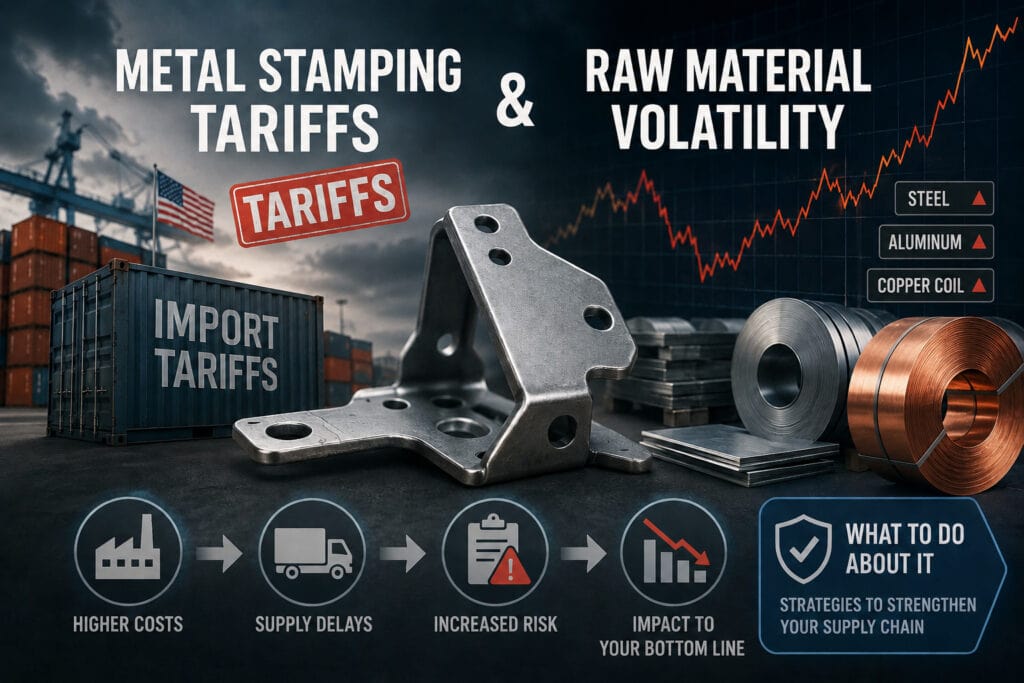
The Section 232 tariff program, originally introduced in 2018 at 25% on imported steel and 10% on aluminum, underwent a dramatic expansion beginning in early 2025. In March of that year, all country-specific exemptions were eliminated, bringing every import source under the tariff umbrella simultaneously. By June 2025, those rates doubled to 50% across the board on steel and aluminum products, with copper added to the program at the same rate in July 2025. The August 2025 expansion added over 400 new tariff codes covering derivative products, meaning that the tariff no longer simply applied to raw coil and sheet, it began reaching further down the supply chain into fabricated and semi-finished components as well.
The April 2026 restructuring introduced a tiered framework: products composed almost entirely of steel, aluminum, or copper now carry a 50% tariff applied to their full customs value, derivative products substantially made from these metals carry 25%, and certain metal-intensive equipment has a temporary 15% rate through 2027. One significant shift in this framework is that tariffs are now assessed on the full entered value of an article, not merely the metal content within it, a change that meaningfully increases the actual duty burden for many importers of fabricated components, even those that previously assumed their exposure was modest. The ripple effects of all this have been measurable: steel mill products are up over 20% and aluminum mill shapes are up approximately 33% year-over-year as of early 2026.
The key takeaway here is not a single number, it is the pattern. Tariff policy in this environment has demonstrated a consistent tendency to expand in scope, increase in rate, and close exemptions over time. Companies that built their procurement strategies around the assumption that today’s tariff structure is the final structure have been repeatedly caught off-guard. The question is not whether this environment is disruptive; it clearly is. The question is how you structure your supply chain to absorb that disruption rather than be undone by it.
Why Offshore Stamping Amplifies the Problem
For years, the allure of offshore stamping was cost-driven: lower labor, lower overhead, and the ability to pass raw material pricing risk onto a distant supplier. That logic was always more complicated than it appeared, as Larson has written about before with respect to quality risk, intellectual property exposure, and supply chain fragility. But in the current tariff environment, the financial calculus has shifted in ways that are difficult to ignore.
A company sourcing stamped parts from overseas now faces not only the direct tariff on imported finished components, up to 25% on derivative metal articles under the current tiered structure, but also the compounding cost of longer lead times, unpredictable duty assessments, and limited ability to respond quickly when policy changes. When Section 232 tariff rates doubled overnight in June 2025, companies with offshore supply chains had very little recourse. Contracts were already in place, tooling was already cut, and the economic assumptions embedded in those decisions were suddenly obsolete. Lead times of 12 to 20 weeks for overseas supply mean that by the time you identify a problem, you are months away from any realistic solution.
Domestic manufacturers are not insulated from rising raw material costs – no one is when commodity markets move as dramatically as they have. But the structure of the exposure is fundamentally different. A domestic stamper procures material from domestic mills and service centers, prices in that material at contract time with visibility into current market conditions and can respond to program changes or material substitutions in weeks rather than months. The tariff asymmetry between domestic production and imported components also means that, for many programs, the true landed cost of an offshore part has moved closer to the cost of a domestic one than it has been in a generation.
How Raw Material Volatility Works in Practice
Understanding the tariff picture is important, but tariffs are only one dimension of the volatility your supply chain faces. Steel and aluminum pricing is driven by a complex interplay of commodity indices, mill capacity utilization, energy costs, transportation costs, and global demand, all of which move independently of trade policy. At Larson, our purchasing team watches these markets closely on behalf of our customers, and the experience of the past several years has taught us that volatility, once it enters the system, tends to stay longer than anyone expects.
When steel prices spiked roughly 3X to 4X between 2020 and 2021, lead times from service centers stretched from 6 to 8 weeks to 16 or 18 weeks in some cases, and spot-buying; the informal safety valve that many stampers and their customers relied on to fill gaps – became effectively unavailable. In fact, domestic mills shut off the spot market. Service centers were working hand-to-mouth, and the buffers that the industry had always been a constant, were gone. Companies that had not thought carefully about their stamper’s material sourcing relationships found themselves without parts. The lesson was painful but important: material risk is a supply chain risk, and it flows directly to production schedules and customer commitments.
Aluminum has shown similar dynamics, with the current tariff environment pushing aluminum mill prices up sharply. Copper’s recent addition to the Section 232 program introduces a new variable for manufacturers of electrical components, connectors, and assemblies. And because these commodity markets are global and interconnected, disruptions that originate far from your facility, in an overseas mining operation, a mill facing a force majeure event, or a trade negotiation between countries that are not even your direct suppliers – can arrive at your door with little warning.
What Domestic Sourcing with the Right Partner Actually Buys You
There is a tendency to frame the domestic-versus-offshore decision as purely a cost comparison, but that framing misses the most important dimension of the choice: optionality. When you source with a domestic precision stamper that has strong supplier relationships, in-house tooling, and genuine material purchasing expertise, you are buying the ability to respond. You can change material grades when supply tightens on a specific alloy. You can expedite a run when your customer’s demand spikes. You can adjust tolerances or redesign a feature in collaboration with an engineering team that is reachable by phone and available to walk your part through their shop floor with you. None of that is available when your tooling is sitting in a factory overseas and your point of contact is up to twelve time zones away.
At Larson Tool & Stamping, our material purchasing function operates as an active risk management discipline, not a passive ordering exercise. We monitor pricing indices, maintain relationships with multiple domestic service centers, and communicate proactively with customers when market conditions are moving in ways that could affect their programs. We build tooling in-house and maintain it in-house, which means we are not dependent on outside vendors when a tool needs repair and production needs to continue.
See a recent blog: https://larsontool.com/blog/larsons-lifetime-tool-guarantee-what-it-means-for-your-budget-and-production/
Our lean manufacturing principles and 6S-organized shop floor are not buzzwords, they are the operating disciplines that allow us to keep our own costs controlled even when input costs are moving, so that we are not passing on avoidable inefficiencies onto our customers on top of unavoidable market increases.
We also believe strongly in transparency about how material pricing works in a stamping program. When you partner with Larson, we help you understand the material component of your part cost, how it is indexed, and how changes in the market are likely to affect your program over time. That kind of visibility is the foundation of a supply chain relationship that can survive volatility rather than simply react to it after the fact.
Practical Steps for Protecting Your Program Right Now
Given the current environment, there are several strategic actions worth considering regardless of whether you are currently sourcing domestically or evaluating a transition. First, if your parts are currently sourced offshore and you have not recently revisited the total landed cost; including current tariff rates assessed on full article value, freight, lead time carrying costs, and quality-related expenses that analysis is overdue. The assumptions from even two years ago are likely out of date in ways that materially change the comparison.
Second, look carefully at your material specifications. Many engineers specify a grade out of habit or conservatism when a more readily available and cost-effective grade would perform equally well for the application. Working with your stamping supplier’s engineering team to revisit material callouts is one of the highest-return conversations you can have right now, because material often represents the largest single cost component in a stamped part. If your current supplier is not proactively having that conversation with you, that itself is useful information.
Third, consider lead time buffers and inventory strategy considering how supply chain disruptions actually manifest. The lesson of 2021 and of every tariff expansion since is that the time between a policy change and its full supply chain impact is short, and the time to recover once you are caught is long. Building even modest finished goods or component inventory of your highest-risk parts can mean the difference between absorbing a disruption and avoiding a complete shutdown.
Finally, evaluate your stamping supplier not just on piece price but on the depth and stability of their material relationships, their tooling and engineering capabilities, and their track record through previous periods of volatility. A supplier who has demonstrated that they can source material reliably, communicate proactively, and maintain quality standards when markets are under stress is a supply chain asset that is very difficult to quantify until you need it – and then it is invaluable.
A Final Word
We are not in a period of temporary disruption that will resolve itself back to a stable baseline once tariff negotiations conclude. The structure of global metals trade, the policy environment around domestic industrial production, and the commodity dynamics driving steel and aluminum pricing all point toward continued volatility. The companies that will manage this best are not the ones that found the cheapest per-piece price on a quiet day in 2022. They are the ones that built supply chain relationships with partners who have the expertise, the infrastructure, and the shared commitment to keep their programs running when conditions become difficult.
That is what Larson Tool & Stamping has been doing for more than a century, and it is what we are built to keep doing. If you are evaluating your precision metal stamping supply chain in the current environment, we would welcome the conversation.
Larson Tool & Stamping Company is a fifth-generation, family-owned precision metal stamper located in Attleboro, Massachusetts, specializing in deep draw stamping, progressive die stamping, and complex metal forming for manufacturers across a wide range of industries. Contact us at (508) 222-0897 X12 or visit larsontool.com.