

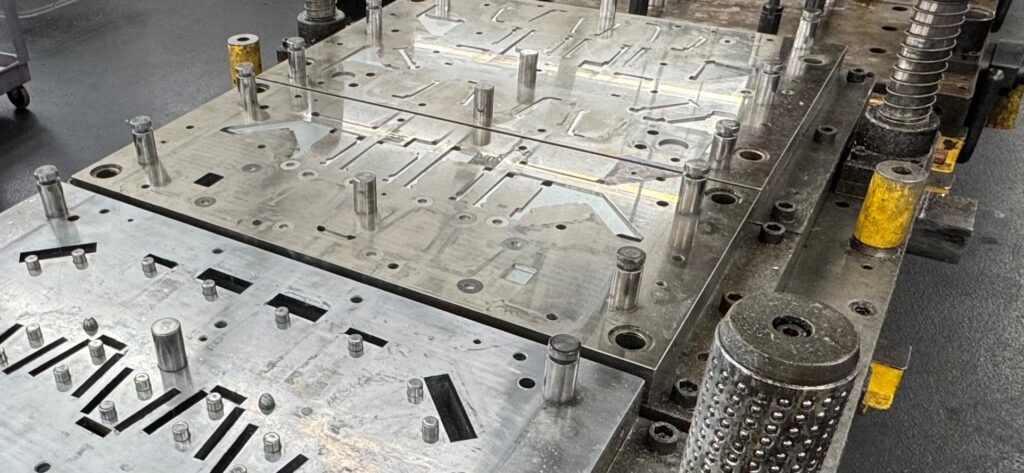
Optimizing part geometry for high-volume metal stamping production is a cornerstone of manufacturing excellence. Manufacturers seeking to balance performance, quality, and cost must consider how design choices resonate through every phase of production—from tooling to forming to final part inspection. A thoughtfully crafted part geometry not only minimizes manufacturing challenges but also extends the life of expensive tooling and ensures consistent production throughput. Conversely, poorly optimized geometry can lead to excessive waste, frequent tool maintenance, and costly production delays. This blog explores the many advantages and common pitfalls of optimizing part geometry for high-volume metal stamping and ultimately explains why partnering with a seasoned industry expert like Larson Tool & Stamping can be a strategic advantage.
In high-volume metal stamping, every detail matters. The geometry of a stamped part— its contours, bends, radii, cuts, and thickness transitions — fundamentally affects how the metal behaves under load. When geometry is optimized, it promotes smooth material flow, reduces stress concentrations, and limits the forces required to shape the part. Smooth, continuous contours tend to draw metal into dies more predictably, minimizing the risk of splits and wrinkles that can compromise part integrity. Designers who understand how metal responds to deformation can create forms with gradual transitions and appropriate radii that reduce the severity of strain imposed during forming. As a result, tool life is extended and production run reliability increases.
Advantages of Optimizing Part Geometry for High-Volume Production
Advantages of optimized geometry become especially clear in operations where volumes are high and customer expectations are stringent. One substantial benefit is increased throughput. When parts are designed with manufacturability in mind, issues such as material hang-ups, blank slippage, or die wear occur less frequently. Throughput is not merely about pressing more parts per hour; it includes the time between press stoppages, the length of preventive tool maintenance cycles, and the speed at which quality parts can be produced without rework. Optimized geometries frequently yield tighter tolerances with fewer secondary operations, meaning that the upstream design decisions reduce downstream bottlenecks.
Reduced production costs is another significant advantage. High-volume stamping operations involve fixed costs that scale with tool life, maintenance, scrap rates, and cycle times. Geometry that minimizes scrap through better material utilization inherently lowers costs. For instance, a part with overly sharp corners might concentrate stress and increase the likelihood of cracking. By smoothing those features, the designer reduces scrap while preserving performance characteristics. Optimized geometry can also minimize the need for expensive secondary operations like precision machining or finishing, further driving down unit costs in mass production.
Beyond throughput and cost, quality and consistency are essential. Customers expect parts that meet exact specifications. Geometry that is well-matched to the strengths of the stamping process tends to yield consistent results over extended runs. This consistency arises because the forming forces are balanced and predictable. When parts avoid features that induce unpredictable deformation, the die is better able to control the material through each stroke of the press. The result is uniformity that is crucial for downstream assembly and functional performance.
Common Pitfalls When Designing Stamped Metal Parts
Despite these benefits, there are numerous pitfalls that can arise during geometry optimization. A common mistake lies in over-engineering for function while under-engineering for manufacturability. Engineers might prioritize the final part performance to the detriment of production realities. For example, intricate details such as acute angles, deep draws, or complex internal features may serve a functional purpose but are difficult to stamp repeatedly without introducing defects. Deep draws, in particular, can induce high tensile strains that exceed the limits of the sheet metal, causing splits. Unless specifically accounted for with progressive tooling strategies, these features can derail production efficiency.
Another frequent pitfall is insufficient attention to material behavior. The choice of material grade and thickness directly affects how metal responds to forming. Some materials, like high-strength steels or advanced high-strength alloys, offer desirable mechanical properties in service but impose greater demands on the stamping process due to reduced ductility. When geometry fails to align with these material characteristics, it can heighten the risk of cracks or excessive springback. Effective geometry optimization must integrate material science insights so that the design complements the chosen material’s capabilities.
A lack of collaboration among cross-functional teams also undermines geometric optimization efforts. Traditional silos in engineering organizations can result in designs that meet theoretical performance objectives but are blind to tooling limitations or production constraints. When designers, manufacturing engineers, and toolmakers are not engaged early and iteratively, geometry decisions may overlook critical factors such as press tonnage limitations, die access for maintenance, or blank holder force distribution. This disconnect can lead to late-stage engineering changes that are costly and time-consuming.
Another challenge arises when geometry is optimized without regard to assembly and lifecycle considerations. Many metal stamped parts are integral to larger assemblies, and their geometry influences how easily they mate with other components. Features that simplify stamping might complicate assembly if fastener locations, alignment features, or mating surfaces are not carefully harmonized. Moreover, over-simplifying geometry to ease stamping might compromise performance in service — for example, reducing stiffness in areas that require rigidity. Balancing manufacturability with functional performance and assembly ease is central to successful design.
The Role of Simulation and Prototyping in Geometry Optimization
Despite the many advantages of optimized geometry, achieving it is an iterative process. Designers must often revise and refine part models based on simulation data, tooling feedback, and real-world production trials. Computer-aided engineering tools, particularly finite element analysis (FEA), can predict material flow and highlight potential problem areas. However, simulation is only as good as the assumptions, material models, and boundary conditions it uses. Realistic validation through prototyping and pilot runs remains essential to confirm that theoretical optimizations yield tangible production benefits.
Why Early Collaboration with a Metal Stamping Partner Matters
Given the complexity of optimizing geometry for high-volume metal stamping, manufacturers benefit greatly from partnering with experienced stamping specialists. A seasoned partner brings not only technical expertise and tooling capabilities but also a depth of historical knowledge from prior projects that helps inform better design decisions upfront. In complex manufacturing environments, early involvement of the stamping partner can illuminate potential production challenges before costly tooling is built. Rather than waiting until after design completion, integrating the partner during early concept development can save significant time and investment.
Larson Tool & Stamping exemplifies the value of such a partnership for companies seeking to optimize part geometry for high-volume production. With decades of experience across diverse industries, Larson Tool & Stamping brings deep understanding of metal forming processes, material behaviors, and tooling design. Our team collaborates closely with customers to evaluate design trade-offs, recommend geometry adjustments, and apply advanced simulation tools that anticipate production outcomes. This proactive approach minimizes surprises during production and helps ensure that parts are manufacturable at scale without sacrificing performance.
Beyond technical insight, Larson Tool & Stamping provides a comprehensive suite of services that streamline the transition from design to production. Our integrated capabilities in precision tooling, progressive die design, and automated stamping operations mean that geometry optimizations are informed by hands-on experience with real press and production environments. This reduces the risk of iterative redesigns after tooling has been finalized. Furthermore, Larson Tool & Stamping’s commitment to quality and continuous improvement helps customers achieve consistent part performance over long production runs, keeping costs predictable and schedules on track.
In conclusion, optimizing part geometry for high-volume metal stamping production offers clear advantages in throughput, cost efficiency, quality, and consistency. Yet the path to optimized geometry is fraught with potential pitfalls ranging from over-complex designs to misaligned material and tooling considerations. Success demands a thoughtful, collaborative process that blends design innovation with manufacturing practicality. Partnering with us can elevate this process, ensuring that geometry not only meets design intent but also supports efficient, high-quality production at scale. With the right expertise and approach, companies can unlock the full potential of metal stamping to deliver parts that perform reliably and profitably in demanding applications.
About Larson Tool & Stamping Company
Since its inception in 1920 in Attleboro, MA, Larson Tool & Stamping Company has been making a difference as a valued supplier of precision metal stampings and assemblies to hundreds of companies in the United States. Larson provides high-quality, cost-effective solutions with our wide range of capabilities that include forming, stamping, deep drawing, machining, assembly, brazing, coining, and water-jetting. Through significant investment in leading-edge manufacturing equipment and the loyal support from customers and co-workers, Larson perpetuates the commitment made by our founders to do whatever is necessary to meet and exceed customer expectations.