

For many purchasing managers, engineers, and sourcing professionals, the moment a purchase order is issued to a metal stamping supplier should feel like progress. Instead, it often introduces a new layer of uncertainty. Questions begin to surface almost immediately. Will the design be interpreted correctly? Will tooling stay on schedule? Will quality issues emerge during sampling, and will communication remain consistent?
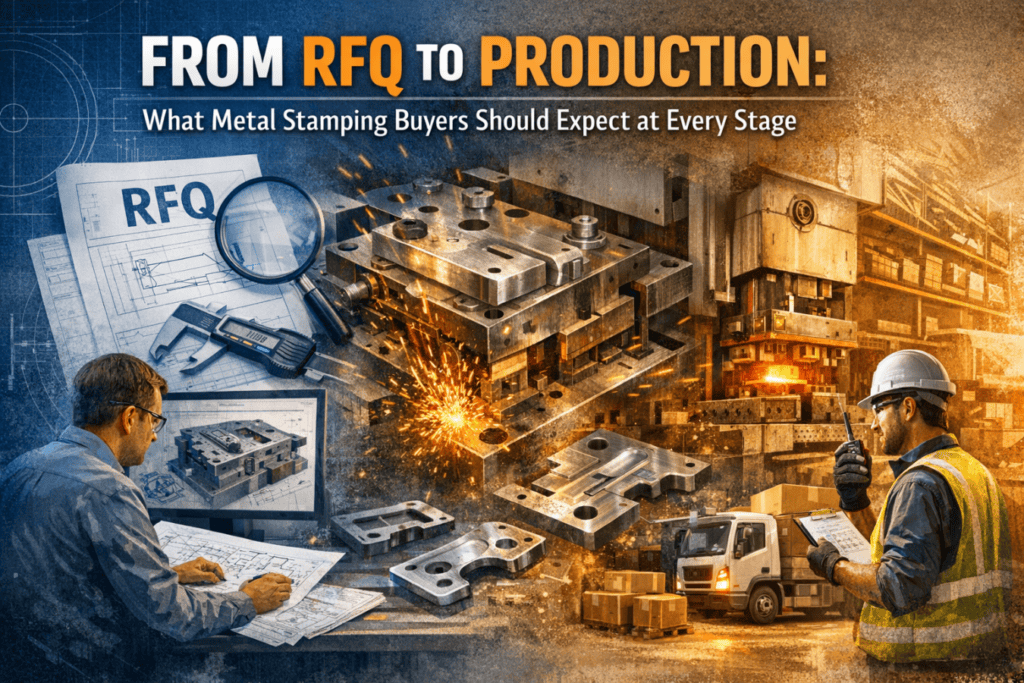
These concerns are not unfounded. In high-volume metal stamping production, the gap between a request for quote and full-scale production is where risk either compounds or is systematically eliminated. The difference lies not just in technical capability, but in how clearly a supplier defines, manages, and communicates each phase of the process.
Understanding what should happen after an RFQ is submitted—and, more importantly, after a purchase order is placed, buyers a framework to evaluate suppliers beyond price. It reveals whether a stamping partner is reactive or disciplined, transactional or collaborative.
RFQ Stage: Feasibility Review and Risk Identification
The journey begins long before the first tool steel is cut. When a supplier receives a request for quote, the most critical step is not simply calculating cost. A capable metal stamper conducts a detailed feasibility review, evaluating part geometry, tolerances, material selection, and production volumes. This stage often determines whether a program will succeed or struggle months later. Subtle design features that may appear insignificant on a print can introduce excessive tool wear, unpredictable springback, or unnecessary secondary operations. A supplier that takes the time to identify these risks early is not slowing the process down—they are preventing costly disruptions downstream.
Engineering Validation After Purchase Order Approval
Once a purchase order is awarded, that early analysis transitions into engineering validation. This is where the theoretical becomes practical. Tooling concepts are refined, strip layouts are developed, and production methods are aligned with real-world manufacturing conditions. Buyers should expect communication during this phase, not silence. Questions, clarifications, and even suggested design adjustments are indicators of a supplier actively working to protect the outcome of the program.
Tooling Phase: Building for Long-Term Production Success
The tooling phase is often where timelines are won or lost. Tool design is not simply about creating a die that produces a part; it is about creating a die that produces consistent, repeatable parts over the life of the program. This requires careful consideration of material flow, wear surfaces, tolerances, and maintenance access. During tool build, disciplined suppliers provide visibility into progress, milestones, and any emerging concerns. A lack of communication here can be a warning sign, as tooling delays have a cascading effect on every subsequent phase.
Sampling Phase: Validating Quality and Process Stability
Sampling represents the first physical validation of all prior decisions. When the first parts come off the tool, they tell a story. They reveal whether the material behaves as expected, whether tolerances can be consistently achieved, and whether the process is stable. For buyers, this is a critical checkpoint. It is not just about whether a part meets specification on paper, but whether it can be produced reliably at volume. A supplier committed to quality will approach sampling as a refinement process, making necessary adjustments to tooling and process parameters to ensure long-term success rather than short-term approval.
Transitioning to Full Production: Ensuring Consistency at Scale
As the program transitions from sampling to production, the focus shifts to consistency. High-volume metal stamping is not about producing one good part; it is about producing thousands to millions of identical parts without deviation. This requires robust process controls, in-process inspections, and a deep understanding of how variables such as material lot variation, tool wear, and press performance impact the final product. Buyers should expect their supplier to have defined quality systems in place that monitor and maintain this consistency, rather than relying on end-of-line inspection to catch issues after they occur.
Equally important during production is communication. One of the most common frustrations buyers experience is a lack of visibility once production begins. Lead times, delivery schedules, and potential disruptions should never come as surprises. A reliable stamping partner maintains open lines of communication, providing updates when needed and addressing concerns before they escalate. This level of transparency not only builds trust but also allows customers to plan their own operations with confidence.
No production program exists in a vacuum, and changes are inevitable. Engineering revisions, volume fluctuations, and unforeseen challenges can all arise over the life of a project. What separates a strong supplier from an average one is how these changes are managed. A disciplined metal stamper approaches change with a structured process, evaluating the impact on tooling, cost, and delivery before implementing adjustments. This ensures that modifications do not introduce new risks or compromise quality.
Unexpected issues are another reality of manufacturing. Tool wear, material inconsistencies, and equipment challenges can occur even in the most controlled environments. The key is not whether issues arise, but how they are handled. A capable supplier identifies problems quickly, communicates them clearly, and implements corrective actions that address root causes rather than temporary fixes. This proactive approach minimizes disruption and reinforces confidence in the partnership.
Why Predictability Is Critical in High-Volume Metal Stamping
Throughout this entire journey, from RFQ to full production, one theme remains constant: predictability. Buyers are not simply purchasing stamped parts; they are investing in a process. The more predictable that process is, the lower the risk and the greater the value. Predictability comes from experience, discipline, and a commitment to doing things the right way at every stage.
For buyers evaluating metal stamping suppliers, this perspective shifts the conversation. Price remains important, but it is no longer the sole determining factor. The true cost of a stamping program includes delays, quality issues, and the internal resources required to manage a struggling supplier. A partner who provides clarity, consistency, and communication reduces these hidden costs and delivers value that extends far beyond the piece price.
How Larson Tool & Stamping Delivers a Controlled, Predictable Process
At Larson Tool & Stamping, this philosophy is embedded in every program. The transition from RFQ to production is not treated as a series of disconnected steps, but as a continuous, managed process designed to eliminate uncertainty. From the earliest stages of design review through tooling, sampling, and full-scale production, the focus remains on delivering consistent results while maintaining open communication with customers. Challenges are addressed proactively, changes are managed thoughtfully, and quality is built into the process rather than inspected at the end.
The result is a manufacturing experience that buyers can rely on. Instead of questioning what happens after a purchase order is placed, customers gain confidence in a process that is transparent, controlled, and aligned with their expectations. In an industry where uncertainty can quickly become costly, partnering with a supplier who prioritizes predictability and accountability is not just an advantage, it is a necessity.
Choosing the right metal stamping partner ultimately comes down to trust. Trust that the supplier understands your part, your timeline, and your expectations. Trust that they will communicate openly and act in your best interest. Trust that they have the systems and experience to deliver consistent quality at scale. Larson Tool & Stamping has built its reputation on earning that trust, program after program, by ensuring that every stage from RFQ to production is executed with precision, discipline, and a clear focus on customer success.
About Larson Tool & Stamping Company
Since its inception in 1920 in Attleboro, MA, Larson Tool & Stamping Company has been making a difference as a valued supplier of precision metal stampings and assemblies to hundreds of companies in the United States. Larson provides high-quality, cost-effective solutions with our wide range of capabilities that include forming, stamping, deep drawing, machining, assembly, brazing, coining, and water-jetting. Through significant investment in leading-edge manufacturing equipment and the loyal support from customers and co-workers, Larson perpetuates the commitment made by our founders to do whatever is necessary to meet and exceed customer expectations.